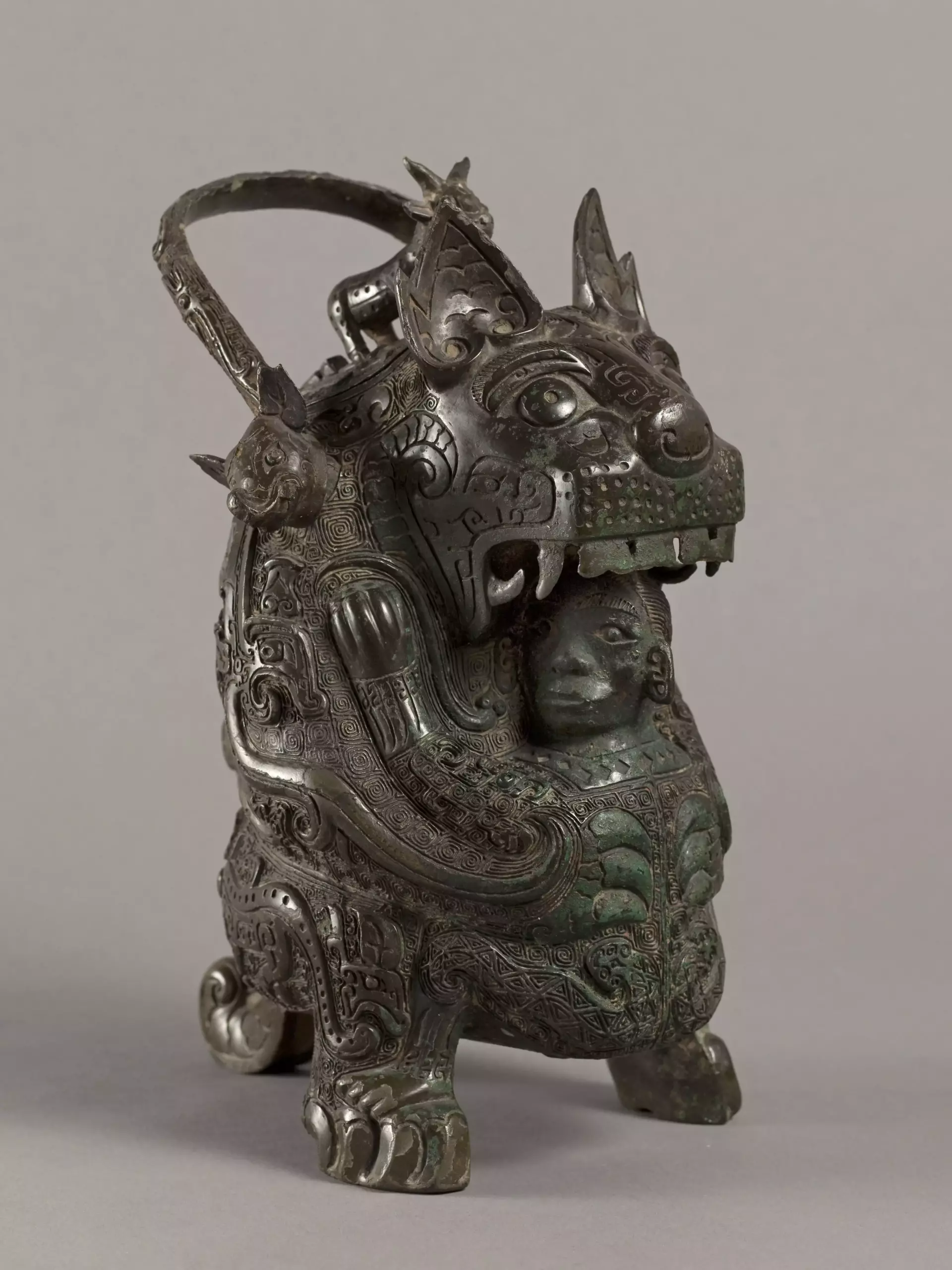
Zoomorphic vessel. A tigress embracing a child, supported as a tripod on her hind legs and tail. The decoration is divided into four zones. This you, intended to contain fermented beverages, is without question the most famous work in the Cernuschi Museum. The piece rests on the animal's two hind legs and the spiral More
tip of its tail. A feline, mouth open, holds in its forelegs a small human nestled against it. The exuberant, almost baroque decoration, made up of large animal motifs with numerous kui-type dragons, stands out against a background of square spirals, characteristic of the late Shang period. The rear of the animal, in the shape of an elephant protome, is particularly majestic. A horned caprid with large ears tops the lid. The handle is attached at the back to animal masks with pointed ears and a curved trunk. The archaeological context of the discovery of this piece is unknown. However, oral tradition places its origin in Hunan, at the foot of Mount Weishan, on the border of the Anhua and Ningxiang districts, west of Changsha. Two elements make this southern provenance plausible: the dark green, almost black bronze has a brilliance lacking in the cleaned vessels of old literati collections, but which matches pieces certainly discovered in Hunan, and zoomorphic you vessels also seem to be characteristic of this province, independent of the more northern Shang kingdom. The theme of a feline associated with a human figure, although attested in the Shang kingdom, is more frequent in the south. It may be linked to a tradition reported by the Zuozhuan, an early commentary on the Annals of Spring and Autumn (8th–5th century BC), which says that the grandson of Ruoao, from the Kingdom of Chu, named Ziwen, was taken in and fed by a tigress when he was a baby. The serene expression of the figure and his feet resting confidently on the feline's paws support this type of explanation. Such a legend is part of totemic narratives that establish the origins of many aristocratic clans, mixing man and beast in a relationship of protection or through a sexual union giving birth to a mythical ancestor. However, it is impossible to identify such an unusual iconography with certainty, and the hypothesis sometimes suggested of a representation of the sacrifice of a slave child, symbolizing evil, cannot be entirely ruled out. Less